
Build a shared mental map of the course so staff understand the enterprise view, the care pathway, the role structure, and the scope boundaries that shape everyday work.
Guided explanation
Module 1 is the foundation course for the full orientation system. Before staff can apply governance requirements, safety expectations, documentation standards, or workflow routines, they need a clear picture of the environment in which those requirements operate. This module provides that picture by introducing the organizational setting, the service pathway, the people who carry responsibility within the system, and the limits of the residential role.
The purpose of this opening section is not simply to welcome the learner. It is to establish the frame through which every later module should be understood. Staff should leave this section knowing that their daily work is connected to larger structures of leadership, clinical coordination, treatment planning, family communication, compliance expectations, and transition planning. Without that shared frame, later instruction can feel disconnected or overly procedural.
A strong orientation process begins by answering four basic questions. Where does this site fit in the enterprise? Where does residential care fit in the client journey? How do roles connect around the work? What should staff manage directly, and what should they coordinate with others? The remaining sections of Module 1 answer those questions in sequence so learners can build understanding in a logical order.
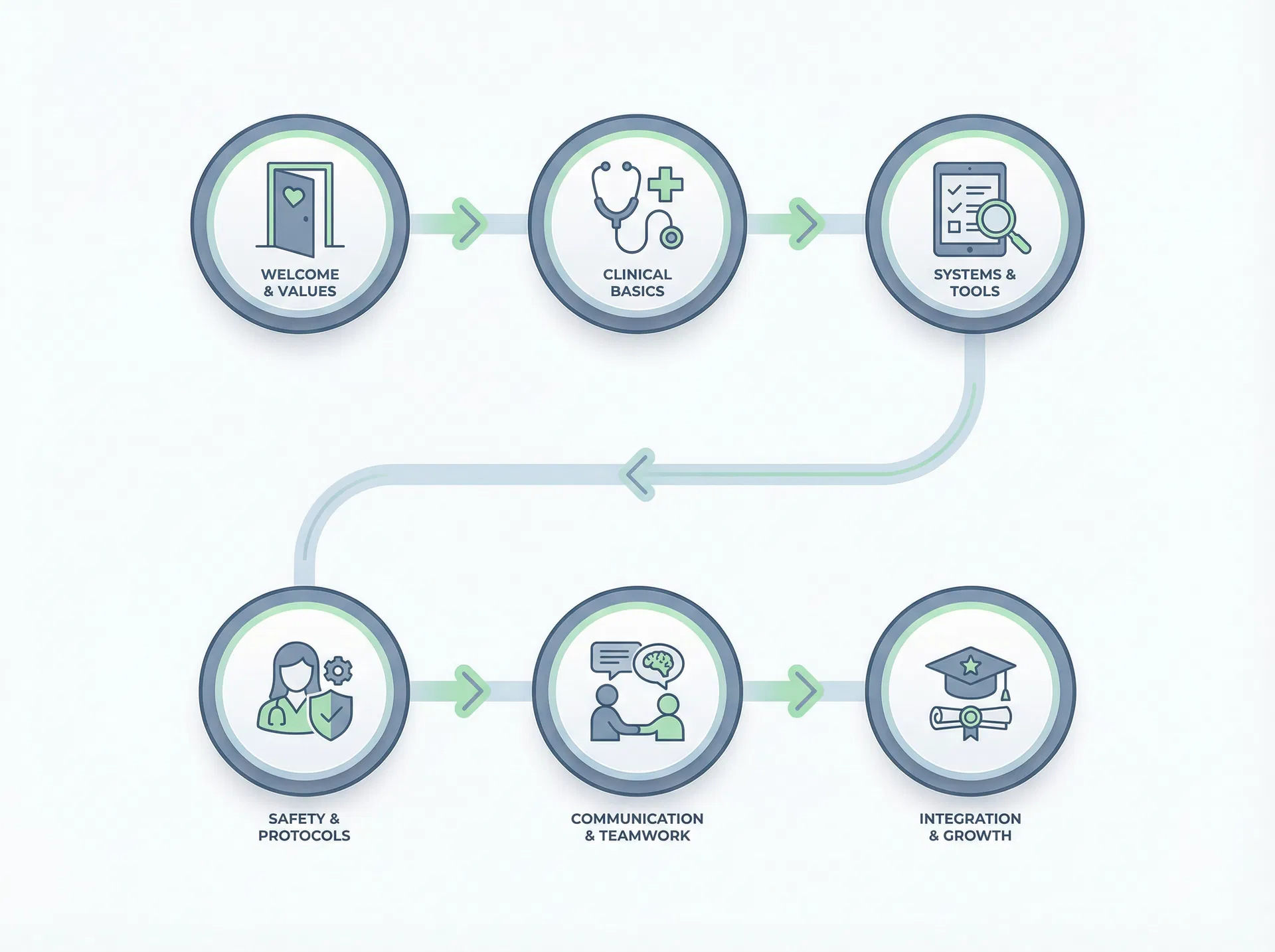
Welcome to the GRO Orientation and Onboarding Learning System. This program is designed as a structured pathway to prepare you for your role, ensuring you have the foundational knowledge and practical skills to operate safely and effectively. The curriculum is not a collection of disconnected topics, but a progressive sequence that builds a chain of readiness. You will begin with universal concepts that apply to everyone, then move into more specialized, role-specific content that prepares you for independent work.
The learning journey is divided into two main parts. The first half focuses on the universal foundation: the enterprise structure, governance standards, safety protocols, operational workflows, and professional communication. This shared language is critical because it ensures everyone is working from the same playbook. The second half of the curriculum shifts to activation and readiness. In these modules, you will see how the foundational knowledge is applied to your specific role, how your competency will be verified through evidence, and how you will be authorized for specific duties under controlled conditions.
Your progress through this system is a partnership between you and your supervisor. Each chapter is a building block, and your understanding will be reviewed at each stage. The goal is not just to complete the material, but to demonstrate that you can apply it in your daily work. Think of this pathway as a coaching tool: first, you build understanding; next, you demonstrate performance; then, your readiness is verified; and finally, you work to maintain quality after you are released into your full responsibilities.
During team meetings or shift handoffs, you will notice that discussions about residents or tasks often reference the standards for safety, documentation, and communication you are learning here.
When a supervisor reviews your documentation or observes your work, they are looking for evidence that you are applying the principles from the foundational modules correctly and consistently.
When a new or unusual situation arises, your ability to recall the guidance on escalation and role boundaries will be critical for a safe and professional response.
Start with context
Understand the enterprise and the residential site as part of a larger operating system rather than as an isolated program.
Move through the care pathway
See how clients enter, move through, and transition across connected points of service.
Clarify responsibility
Learn how leadership, clinical, administrative, and direct-care roles contribute to safe, coordinated services.
Define boundaries
Identify where residential responsibility is appropriate and when referral, escalation, or coordination is required.
Chapter visual
Course map and learning orientation
By the end of this section, the learner should be able to:
State the overall purpose of Module 1 in plain language.
Identify the four major learning questions that structure the course.
Recognize why later modules depend on this shared foundation.
What Breaks Down When This Is Misunderstood
Learners treat the orientation modules as a checklist to be completed quickly rather than an opportunity to build a real mental model of the operation.
Staff see the foundational modules on governance and safety as generic background, failing to connect them to the high-stakes activation and readiness decisions that come later.
Supervisors sign off on module completion without confirming that the learner can actually apply the concepts in practice, leading to a gap between theoretical knowledge and real-world performance.
Decision Cues for the Learner
When a new task feels disconnected from your core duties, is it because the broader enterprise context is missing?
When a workflow seems overly procedural, is it because the underlying governance or safety reason has not been made clear?
When you are asked to complete a module, are you treating it as a standalone task or as one link in a chain of readiness?
Practice Lens
In practice, you might be tempted to view this orientation as just another set of training modules to get through. However, the real test comes when you are on the floor, and a situation arises that is not in any textbook. In that moment, your ability to recall the underlying principles of safety, governance, and communication will guide your judgment. This curriculum is designed to build that deep, instinctual understanding, so when you face a difficult decision, you are not just guessing. You are drawing from a solid foundation of professional practice that you started building right here.
Evidence of Understanding
Can the learner explain why the curriculum is structured as a progressive pathway rather than a simple library of topics?
Does the learner connect the foundational modules to the later activation and readiness controls?
Is the shared vocabulary from the orientation system being used correctly in supervision, documentation, and team communication?
Why this matters
When staff understand the whole system first, later instruction becomes easier to apply. Procedures make more sense when learners know the structure, relationships, and boundaries that sit behind them.
Chapter completion
Complete this chapter, then return to the course board.
Finish one chapter at a time. Once a chapter is complete, continue directly to the next chapter. After the final chapter, mark the full module complete and return to the course top.